
Today’s NYT Connections puzzle has a sneaky little trap that can easily leave you stuck on your final guess. Puzzle #1199, for Tuesday, September 22, 2026, looks fairly approachable at first, but a clever wordplay category makes things much trickier than they seem.
If you only want the answers, you can jump straight to the solution section. Otherwise, start with the hints below and see if you can crack the grid without spoilers.
What Is NYT Connections?
Connections is The New York Times’ daily word puzzle where you’re given 16 words and need to sort them into four groups of four.
Each group has its own difficulty color. Yellow is generally the easiest, followed by green and blue, while purple is usually the most challenging.
You get just four incorrect guesses before the game ends, so it’s worth taking a second look whenever several words seem to fit the same category.
Today’s Connections Hints for September 22, 2026
Need a little nudge without seeing the answers? Here are today’s four categories, from easiest to hardest:
- Yellow: Indicating position and count
- Green: Cherry on top
- Blue: Data gathering points
- Purple: Drinks missing a mark
Still can’t see the connections? No worries. The complete answers are below.
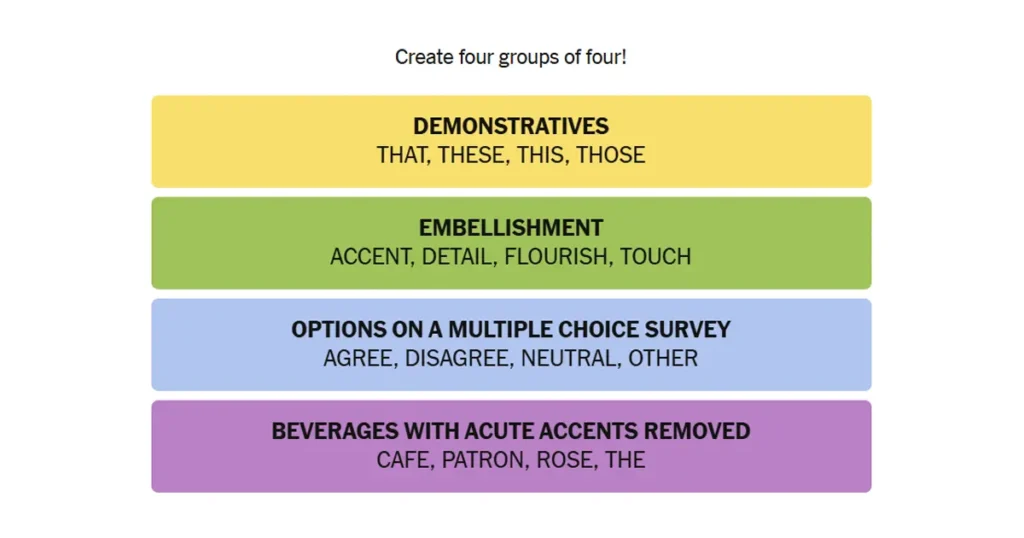
NYT Connections Answers for September 22, 2026
Yellow: Demonstratives
THAT, THESE, THIS, THOSE
These are demonstrative pronouns. They point to a particular person, thing, or group, while also helping indicate whether it’s singular, plural, near, or farther away.
It’s the kind of category that looks easy once you spot it, but a couple of the other words can make the group less obvious at first.
Green: Embellishment
ACCENT, DETAIL, FLOURISH, TOUCH
All four words can describe something added to give an object, design, meal, or idea a little extra character.
A designer might add a flourish to a logo, while a small touch or detail can make something stand out. An accent can work in much the same way.
Blue: Options on a Multiple Choice Survey
AGREE, DISAGREE, NEUTRAL, OTHER
These are the sort of responses you might see on a survey or feedback form.
Agree and disagree are obvious choices, while neutral and other round out the possible responses. None of the words looks particularly unusual on its own, which is part of what makes this group easy to overlook.
Purple: Beverages With Acute Accents Removed
CAFE, PATRON, ROSE, THE
This is where today’s puzzle gets tricky.
Each word becomes the name of a beverage when you restore an acute accent:
- CAFE – café
- PATRON – Patrón
- ROSE – rosé
- THE – thé
And THE is the real trap. At first glance, it looks like it could belong with THAT, THESE, THIS, and THOSE. That’s exactly the sort of overlap Connections likes to throw at you.
ACCENT is another potential distraction because it belongs in the green group while also being the clue to what the purple words have in common.
Quick Connections Answer Recap
- Yellow: Demonstratives – THAT, THESE, THIS, THOSE
- Green: Embellishment – ACCENT, DETAIL, FLOURISH, TOUCH
- Blue: Options on a Multiple Choice Survey – AGREE, DISAGREE, NEUTRAL, OTHER
- Purple: Beverages With Acute Accents Removed – CAFE, PATRON, ROSE, THE
Why Today’s Puzzle Is So Tricky
The purple group does a great job of borrowing words and ideas from the other categories.
ACCENT belongs with the green answers, but it also points toward the missing punctuation in the purple group. Then there’s THE, which looks like a natural fit for the demonstratives category until you realize it’s hiding THÉ.
That’s the kind of wordplay that can make you burn through your guesses even when you’ve already spotted several correct connections.
How to Get Better at Connections
A few habits can make these puzzles much easier:
- Look at the entire grid first. Don’t lock in the first group you notice without checking the remaining words.
- Start with your strongest connection. The yellow group is often a good place to begin.
- Be suspicious of words that fit multiple groups. They’re frequently there to distract you.
- Leave the strangest words until later. Once you’ve removed the obvious groups, the harder connection usually becomes clearer.
- Think beyond the literal meaning. Connections often relies on wordplay, alternate meanings, spelling, or pronunciation.
Final Thoughts
Puzzle #1199 is a good example of why Connections can feel so deceptively difficult. The individual words aren’t especially complicated, but the overlapping possibilities can send you in completely the wrong direction.
The accent-mark trick in the purple category is especially sneaky. Once you see it, the answer feels obvious. Before that, though, THE and ACCENT can make the grid surprisingly difficult to untangle.
Come back tomorrow for the next NYT Connections hints and answers, and check GamerUrge for more daily puzzle guides, gaming news, and helpful walkthroughs.