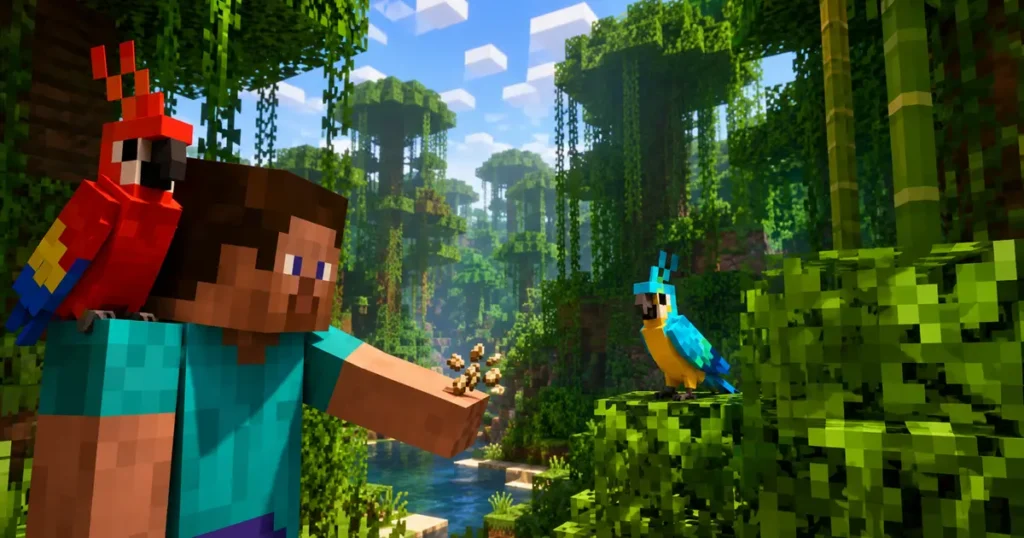

Minecraft is full of pets you can recruit, but none of them have quite the same personality as a parrot. They won’t swing a sword or haul your loot around, yet once one’s perched on your shoulder, it’s hard to imagine exploring without it.
The short version: track one down in a jungle, offer it seeds, and wait it out. Eventually a set of hearts will pop above its head and that’s your sign it’s bonded to you. But there’s a right way to go about it, plus some quirky rules once your new bird buddy is officially yours, so let’s get into the details.
Jungle Biomes Are the Only Place You’ll Find Them
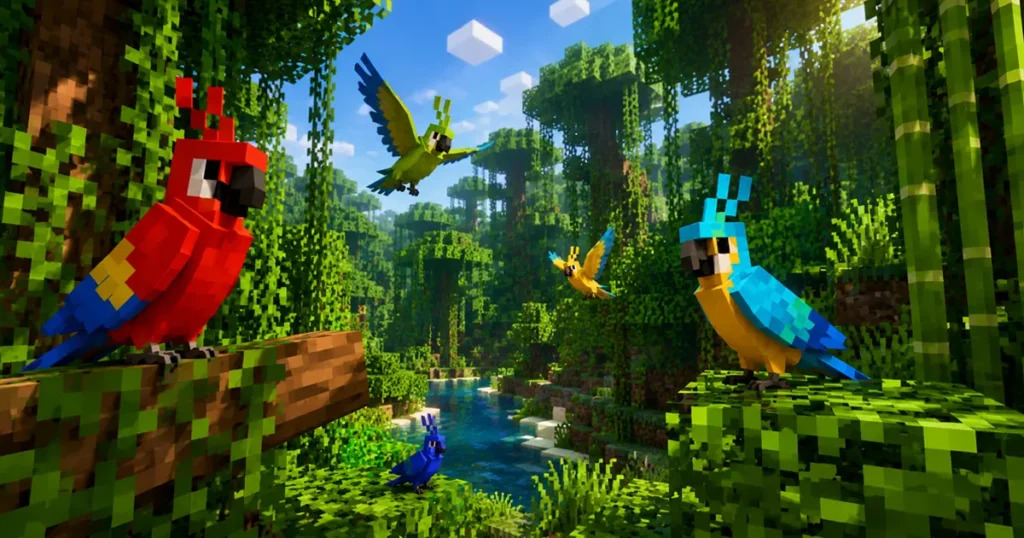
Parrots are picky about real estate. They only show up in jungle-type biomes, which covers the standard jungle, the bamboo jungle variant, and the sparser jungle biome too. Don’t bother scanning plains or forests looking for one; it just won’t happen outside jungle terrain.
Jungles can be a maze of vines and thick canopy, so scanning both the treetops and the forest floor helps. Their bright feathers usually stand out against all that green once you’re actually in the right spot.
Seeds Are the Key to Winning a Parrot Over
Don’t wander into the jungle empty-handed. A parrot will happily eat several different seed types, and any of these will work for taming:
- Wheat Seeds
- Pumpkin Seeds
- Melon Seeds
- Beetroot Seeds
- Torchflower Seeds
- Pitcher Pods
Here’s the part a lot of new players don’t expect: feeding a seed doesn’t guarantee success. Each one only carries roughly a 10% shot at taming the bird. In practice, that means bringing a stack of about ten seeds is a smart move if you want good odds of taming it during one visit, though the RNG could work in your favor much sooner.
Also read: Minecraft Java Edition Gets First PC Spec Update in 17 Years
Step-by-Step: Taming Your Parrot
Once you’ve got your seed supply and you’re standing in jungle territory, here’s how the actual taming process plays out:
- Scan the area for a wild parrot resting in the branches or hopping around nearby.
- Approach carefully with a seed selected. Rushing at it will scare it off before you get a chance.
- Right-click on the parrot (or use whatever your platform’s interact button is) while it’s targeted to offer it the seed.
- Keep feeding seeds this way, one at a time, until you see red hearts float above its head.
That heart animation is your confirmation. The parrot now recognizes you as its owner and will follow you from that point forward.
What to Expect From a Tamed Parrot
Getting the parrot tamed is really just step one. These birds come with a handful of unusual behaviors you won’t find on any other Minecraft companion.
They’ll Perch Right on Your Shoulder
There’s no special button or command needed here. Simply get close to your tamed parrot while it isn’t already sitting down, and it’ll climb up onto your shoulder by itself. From there it mirrors your movement, turning its head in whatever direction you’re facing, which honestly makes it one of the more memorable pet interactions in the game.
That shoulder ride isn’t permanent, though. Your parrot will jump down and fly off if any of the following happen:
- You take damage of any kind
- You step into water
- You walk through powder snow
- You go to sleep in a bed
- You take off using an Elytra
- You fall from a tall drop
- You land somewhere noticeably higher up than before
- You switch into Creative Mode and start flying
Also read: How to Get Explosive Sulfur Cube in Minecraft
Cookies Are Genuinely Dangerous to Parrots
Here’s a detail plenty of players learn the hard way: giving your parrot a cookie is a bad idea. On Java Edition, it’ll kill the bird right away. Bedrock Edition handles it a little differently, poisoning the parrot until it dies instead.
There’s actually some real-world logic behind this mechanic. Cookies contain cocoa, and cocoa-based chocolate happens to be toxic to real parrots too. Mojang clearly built that detail into the game on purpose, so once you’ve put in the effort to tame one, keep cookies far away from your new pet.
They’ll Copy Nearby Monster Noises
A tamed parrot picks up on hostile creatures in the area and starts imitating their sounds. Depending on which version of Minecraft you’re playing, that list can include Creepers, Zombies, Skeletons, Endermen, the Warden, Blazes, Ghasts, Pillagers, and Piglins.
It’s more than just a fun quirk, too. Hearing your parrot suddenly mimic a Creeper hiss is a solid heads-up that something dangerous might be lurking close by, even before you’ve spotted it yourself.
They Bust a Move When Music Plays
Drop a Jukebox down near your parrot and slide in any music disc, and watch it start bobbing its head and grooving along to the beat. It doesn’t matter whether it’s sitting in a tree or riding on your shoulder at the time. As soon as music starts playing within range, the parrot joins in.
Common Questions
Q. What does a parrot eat in Minecraft?
Q. How many seeds are needed to tame one?
Q. Is it possible to breed parrots in Minecraft?
Wrapping Up
Taming a parrot in Minecraft doesn’t take much beyond a jungle biome, a stack of seeds, and a little patience. Once it’s yours, you get a shoulder companion that reacts to music, warns you about nearby danger, and adds a splash of personality to your world. Just steer clear of feeding it cookies, and you’re set.
Now that you’ve got a parrot perched on your shoulder, why stop there? Browse more GamerUrge Minecraft guides for taming other creatures, hunting down rare seeds, and gearing up for your next adventure. Let us know in the comments what you named your parrot.