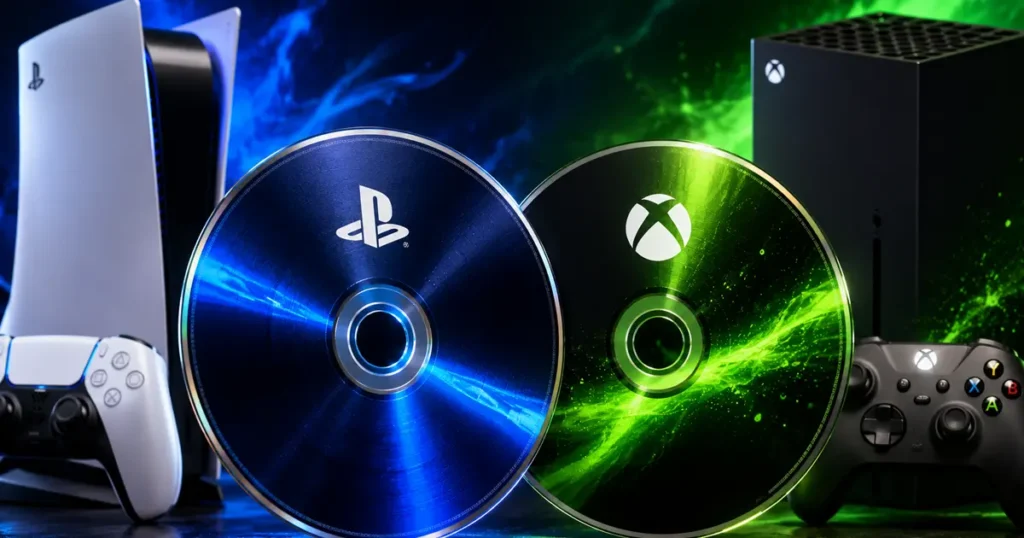

Every PS5 and Xbox disc starts out as a glass disc the size of a dinner plate. That glass master gets etched with a laser, turned into a metal stamper, and then used to stamp out thousands of plastic copies an hour on a factory line. It is a much more industrial process than most gamers picture, and it is also a process that is about to change forever.
Sony confirmed in July 2026 that it will stop producing discs for new PlayStation games starting in January 2028. Games that already came out on disc will stay available, but every new release after that date goes digital only. That announcement is exactly why this is the right moment to explain how disc games get made in the first place, and why the whole system is winding down.
How Are PS5 and Xbox Discs Made?
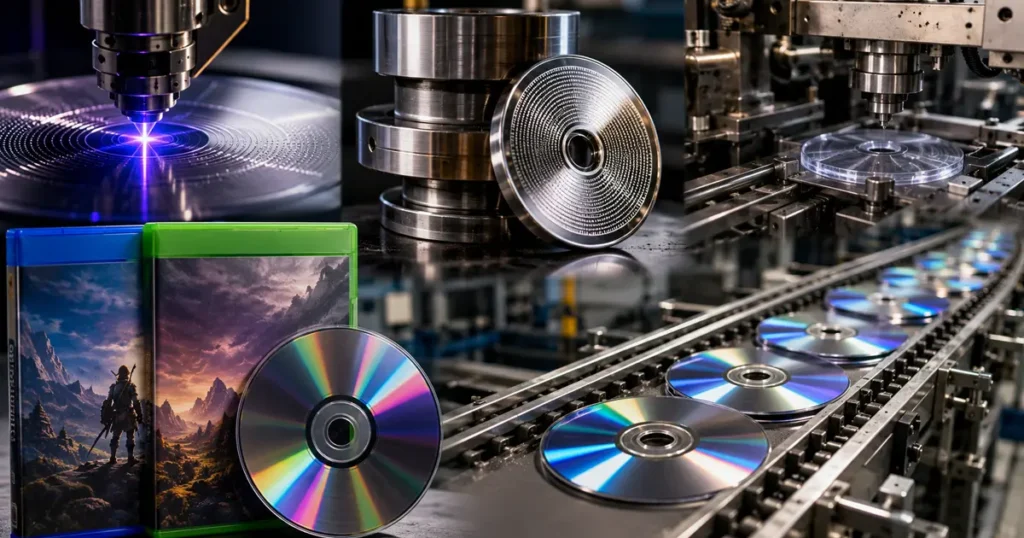
Disc games are not recorded one copy at a time like burning a DVD at home. They are mass produced from a single master copy in a process called replication.
Here is the short version:
- A glass master gets etched with the game’s full code using a laser
- That glass master becomes a metal stamper through an electroforming process
- The stamper presses thousands of plastic discs through injection molding
- Each disc gets a reflective coating so consoles can read it
- A protective lacquer layer and printed artwork finish the job
Each of those steps happens in a real factory, not a server room, which is part of why physical games cost more to produce than digital ones.
Step 1: Building the Glass Master
Manufacturers start with a polished glass disc that is bigger and thicker than a normal Blu-ray. A laser beam recorder etches the entire game’s data onto this glass in a spiral pattern of microscopic pits, the same basic method used for CDs and DVDs before it, according to VDC Group’s breakdown of the mastering process.
This glass master has to be almost flawless. Even a speck of dust can throw off the entire batch of discs made from it.
Also read: Addison Rae Fortnite Skin: How to Get It, Price & Bundle
Step 2: Turning the Master Into a Stamper
The glass master then goes through electroforming, where a nickel layer builds up on its surface inside a plating bath. Once that nickel layer is thick enough, it gets peeled off the glass to form a hardened negative copy of the data pattern called a stamper.
This stamper is what actually gets loaded into a factory machine. One stamper can be used to press tens of thousands of discs before it wears out.
Step 3: Mass Producing Discs Through Injection Molding
Once the stamper is ready, production moves fast. Molten polycarbonate plastic gets injected into a mold containing the stamper, and within seconds a clear disc imprinted with the game’s data pops out.
Modern replication lines can produce well over a thousand discs per hour once they’re running at full speed.
Step 4: Coating and Finishing
Each freshly molded disc still cannot be read by a console yet. It needs a thin reflective metallic layer so the laser inside a PS5 or Xbox can actually pick up the data.
After that, a protective lacquer layer gets added to guard against scratches, and the disc’s label artwork gets printed directly onto its surface. That finished disc is what eventually ships inside a game case.
Why Sony and Microsoft Handle Disc Production Differently

Publishers cannot just send a finished game to any factory willing to press it. Sony requires developers to route their master discs through a Sony-designated manufacturing facility and pass the platform’s own testing and approval process before mass production begins.
Microsoft runs a similar system on Xbox, requiring publishers to use Microsoft-approved replicators and clear staged certification checkpoints before a game gets cleared for disc production.
This is part of why disc production usually locks in weeks or months before a game actually launches. Discs need time to sit in warehouses ready to ship on day one, which is also part of why day-one patches sometimes end up bigger than the disc itself.
Some upcoming Xbox titles have reportedly only gotten physical disc versions on PlayStation, not on Xbox, based on retailer listings reported by Insider Gaming. That is a small but telling sign of how differently the two platforms are treating physical media as digital sales keep climbing.
Also read: Sony’s New PlayStation Controller Patent Could Change Gaming Forever
What Happens to Physical Games After 2028?
Sony’s shift away from discs is not a total shutdown overnight. Sony sent a private memo to its publishing partners confirming that re-orders for already-released PlayStation disc games will still be possible after the cutoff date.
In other words, if a game already came out physically before January 2028, publishers can still order more copies of that same disc afterward. New games releasing after the cutoff simply will not get a disc option at all.
Sony’s Austrian manufacturing facility is reportedly already retraining staff to prepare for the wind-down, which suggests the disc pipeline will shrink dramatically rather than vanish in a single day.
Why Is Sony Ending Physical PlayStation Discs?
Sony has said the move reflects how most PlayStation owners already buy their games. According to TechCrunch’s coverage of the announcement, Sony framed the decision as a natural shift to match how the majority of its community already prefers to access games.
Recent figures put digital purchases at close to four out of five full game sales on PS4 and PS5, based on NPR’s reporting on the announcement. That trend, combined with the cost of running physical replication lines, is a big part of why Sony picked disc production as the thing to cut.
The same announcement also confirmed that Sony will shut down the PlayStation Store on PS3 in select regions later in 2026, followed by a global closure of the PS3 and PS Vita stores the following year, according to CNBC’s report on the news.
Is Xbox Also Getting Rid of Discs?
Microsoft has not made a matching announcement, but the signs point in a similar direction. Rumors of a disc-less Xbox Series X variant have circulated for a while, and reports say Microsoft has also been testing a feature called Disc2Digital that would let owners convert older physical Xbox games into digital licenses.
Xbox has already leaned harder into digital than PlayStation has, largely thanks to Xbox Game Pass. A firm cutoff date for Xbox discs has not been announced, but the direction of travel looks familiar.
Final Thoughts
Physical disc production for PlayStation and Xbox games is a real manufacturing process involving glass masters, nickel stampers, and injection molding, not something that happens with the push of a button. It is also a process on a clear timeline toward the exit, at least for new PlayStation releases starting in 2028.
For collectors, the next couple of years look like the last real window to pick up new AAA games on disc before the format quietly steps aside for digital downloads.
Want more breakdowns like this one? Follow GamerUrge for the latest PlayStation and Xbox news, guides, and everything else happening in gaming.