Saturday’s NYT Connections puzzle has a sneaky purple category hiding in plain sight. If you’re looking at all 16 words and trying to avoid wasting your guesses, this guide should help you crack it.
Today’s puzzle is Connections #1196 for September 19, 2026. The four groups involve ways to widen your scope, things you might find in a kid’s drawing, words associated with Swinging London in the 1960s, and phrases that begin with abbreviated math functions.
We’ll start with the hints before revealing the answers, so you can stop before the spoilers if you’re still solving.
Today’s NYT Connections Words
Here are all 16 words in today’s puzzle:
STICK FIGURE, MINISKIRT, LOG CABIN, SUN, TAN LINE, BRANCH OUT, HOUSE, TWIGGY, TREE, MOD, SIN CITY, GROW, COS LETTUCE, EXPAND, CARNABY STREET, DIVERSIFY
NYT Connections Hints for September 19
Need a little help but don’t want the answers just yet? Here are the clues, starting with the easiest category and working toward the trickiest.
- Yellow: Think about expanding beyond what you normally do.
- Green: Think of the simple things kids often draw with crayons.
- Blue: Think about London’s fashion and youth culture during the 1960s.
- Purple: Pay attention to how the words begin rather than what the complete phrases mean.
Still stuck on purple? Take a closer look at LOG, SIN, COS, and TAN. They should look familiar if you’ve ever used a calculator.
What Are Today’s NYT Connections Answers?
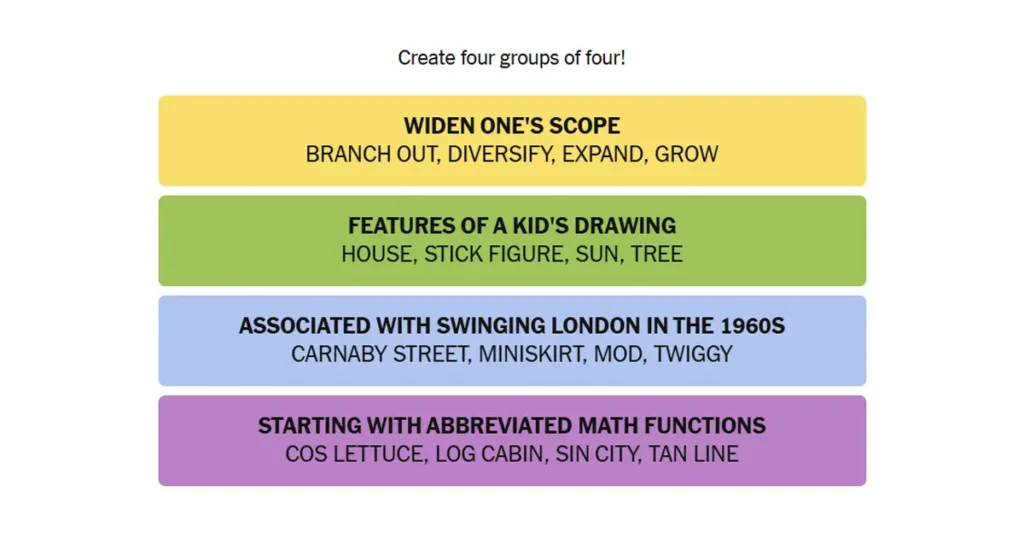
If you’re ready for the solution, here are all four groups for Connections #1196:
- Yellow: Widen one’s scope – BRANCH OUT, DIVERSIFY, EXPAND, GROW
- Green: Features of a kid’s drawing – HOUSE, STICK FIGURE, SUN, TREE
- Blue: Associated with Swinging London in the 1960s – CARNABY STREET, MINISKIRT, MOD, TWIGGY
- Purple: Starting with abbreviated math functions – COS LETTUCE, LOG CABIN, SIN CITY, TAN LINE
How to Solve Each Group
Yellow: Widen One’s Scope
This is probably the most straightforward group on the board.
BRANCH OUT, DIVERSIFY, EXPAND, and GROW can all describe moving beyond your current limits, interests, or area of activity.
If you’re looking for a safe starting point, this is a good group to grab first.
Green: Features of a Kid’s Drawing
Think back to those classic childhood drawings.
A HOUSE, STICK FIGURE, SUN, and TREE are all common features you might see in a simple kid’s picture.
The tricky word here is TREE, since it can easily make you start thinking about nature-related connections. In this puzzle, though, it belongs with the basic elements of a child’s drawing.
Blue: Associated With Swinging London in the 1960s
This group takes you back to the fashion and youth culture of 1960s London.
CARNABY STREET was closely associated with the era’s fashion scene, while the MINISKIRT became one of the decade’s most recognizable fashion trends.
MOD refers to the style and youth movement associated with the period, and TWIGGY was one of Britain’s most famous models of the 1960s.
Purple: Starting With Abbreviated Math Functions
Here’s where today’s puzzle gets clever.
The four answers are:
- COS LETTUCE
- LOG CABIN
- SIN CITY
- TAN LINE
Look at the first three letters of each phrase: COS, LOG, SIN, and TAN.
They’re all abbreviations used for mathematical functions on a calculator.
The rest of each phrase has nothing to do with mathematics. That’s the trick. You’re supposed to focus on the beginning of each answer rather than its overall meaning.
Which Tiles Are the Biggest Traps?
There are several words here that can easily pull you toward the wrong category.
- STICK FIGURE, BRANCH OUT, LOG CABIN, and TWIGGY might make you think there’s a tree or wood-related group.
- TWIGGY actually belongs to the 1960s London category.
- LOG CABIN looks like it could belong with nature or outdoor terms, but it’s part of the purple group.
- TREE and SUN might seem like obvious nature words, but they belong with the features of a kid’s drawing.
That’s classic Connections design. Several words are meant to look like they belong together, even though only four actually share a category.
Tips for Solving NYT Connections Faster
Want to get better at these puzzles? A few simple habits can make a difference:
- Look for wordplay early. Purple categories often depend on spelling, prefixes, sounds, or other tricks.
- Watch for double meanings. A word that seems to fit one group might actually be there to distract you.
- Try rearranging the board. Changing the order can help you see combinations you missed.
- Don’t lock in a group too quickly. If one word feels questionable, there may be another category hiding underneath it.
- Remember your mistake limit. You can make three incorrect guesses before the puzzle ends.
How Does NYT Connections Work?
NYT Connections is a daily word puzzle from The New York Times. You’re given 16 words and need to sort them into four groups of four, with each group connected by a hidden theme.
The categories are color-coded by difficulty. Yellow is generally the most straightforward, followed by green, blue, and purple, which is usually the trickiest.
A new puzzle becomes available each day, giving players another 16-word challenge to solve.
Final Thoughts
Connections #1196 is a good example of how the puzzle can hide an answer in something as simple as a word’s first few letters.
The yellow group is fairly direct, while the green category relies on familiar childhood drawings. The blue group requires some knowledge of 1960s London culture, and the purple group is all about spotting those sneaky math abbreviations.
If you solved the whole thing without making a mistake, well done. If the purple group caught you off guard, you definitely weren’t alone.
Looking for more daily puzzle guides, gaming news, and helpful guides? Keep visiting GamerUrge for more updates.