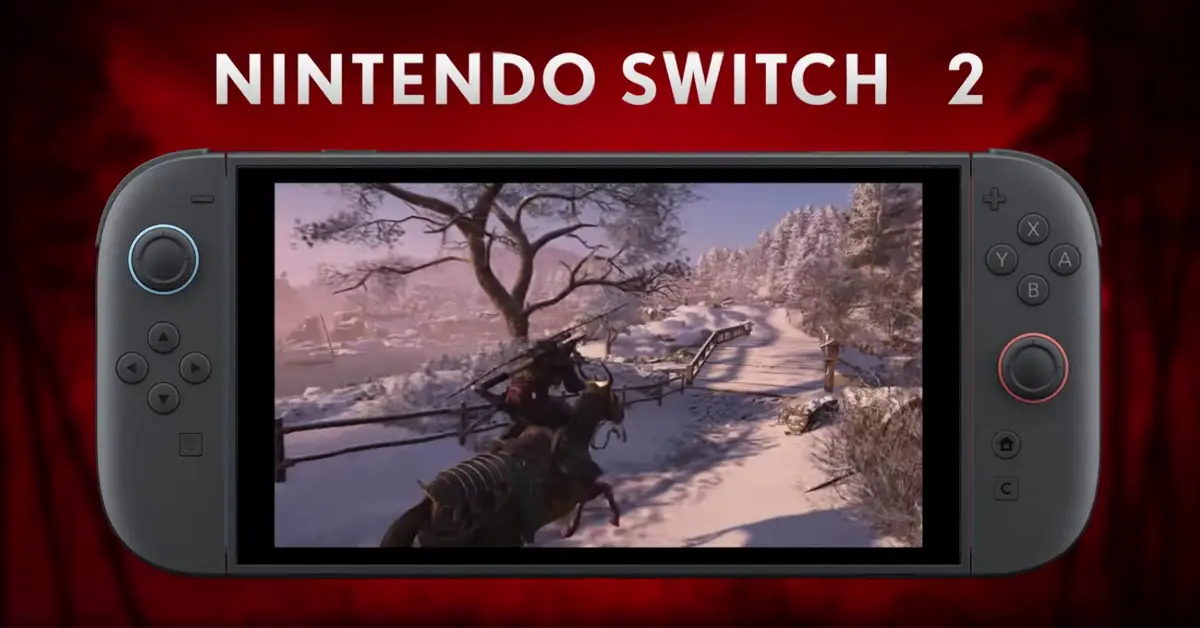
Assassin’s Creed Shadows finally arrives on Nintendo Switch 2 on December 2, and fans who waited for a portable version can now see how Ubisoft adapted such a massive open world adventure to a smaller system. The original release was built around high end hardware on PC, PlayStation 5, and Xbox Series X|S. That meant the Switch 2 version needed a different approach. Rather than simply lowering settings, Ubisoft reworked core parts of the engine so the game would feel complete while still fitting the console’s limits.
When Shadows first launched, it introduced major upgrades to the Anvil engine. It featured ray traced lighting, ray traced reflections, fluid driven wind and rain, and a dense micropolygon system that allowed the game to draw highly detailed terrain. Clouds, cloth, destruction, foliage, and streaming systems were also rebuilt. Those features push modern consoles hard, and the Switch 2 cannot run them at the same level. Ubisoft knew this early, so the team started by figuring out which systems needed to be preserved and which could be restructured.
Rebuilding the World for Switch 2
The team kept the core simulations that bring life to the world. Cloth still moves, clouds still shift across the sky, and weather patterns still interact with trees, leaves, and objects. These systems were scaled down so they consume less GPU power. The main goal was not to remove features but to simplify how often they update or how many layers they use.
Lighting was one of the biggest changes. Shadows uses ray traced global illumination on stronger platforms, but Switch 2 relies on a baked lighting solution. Ubisoft already used this method on low spec PCs and the Xbox Series S, so the adjustment made sense. This saved memory and removed the need for real time ray tracing, which would have placed pressure on the GPU that the handheld simply cannot handle.
Draw distances, level of detail, textures, and object streaming were all adjusted for different areas. Cities with heavy crowds now have reduced NPC counts in very busy plazas. Smaller towns and open regions keep more of their original detail. Ubisoft tuned each zone separately instead of applying one global reduction across the entire map.
DLSS, Stability, and Performance
The Switch 2 supports NVIDIA DLSS, which was a major help. The game renders at a lower internal resolution and then uses DLSS to rebuild a sharper image. This allows the hardware to run the game more comfortably while still producing a clean output.
After months of testing, Ubisoft locked the game to 30 frames per second in both handheld and docked modes. Docked mode takes advantage of the higher power budget. You get sharper textures, longer draw distances, and more detail overall. Handheld mode reduces some of that to stay within the power limits of portable play.
A unique twist is the use of variable refresh rate. Normally VRR cannot function at 30 frames per second because the lower limit hovers near forty. Ubisoft built a custom algorithm that forces VRR to remain active at thirty. This improves frame pacing and reduces small stutters, which helps combat and exploration feel smoother.
Touch Controls and Future Support
Ubisoft added Switch specific features that make the version feel at home. Touchscreen support is available for menus, the world map, and hideout interactions. It makes navigation easier when playing in handheld mode. For docked mode, Ubisoft revealed plans to add mouse and keyboard compatibility at a later date. That is a feature you rarely see on consoles and could appeal to players who prefer that setup.
Cross progression works through Ubisoft Connect. If you already started the game on another platform, you can continue right where you left off on Switch 2. All updates released so far are included at launch. Future patches will arrive on Switch 2 at the same time as other platforms.
The only missing piece is the Claws of Awaji expansion. It will not be available at launch and is scheduled for 2026. Ubisoft also confirmed it will be the only major expansion for Shadows.
What Players Can Expect
The Switch 2 version keeps the story, world, and core gameplay intact. Most of the visual cuts happen in crowded areas or scenes with complex foliage. Open regions look close to the original release, and the atmosphere remains strong. The combination of DLSS, VRR, and stable frame pacing makes this version feel more polished than a straightforward downgrade.
Final Thoughts
Assassin’s Creed Shadows on Switch 2 is a carefully engineered port. Ubisoft respected the limits of the hardware while keeping the full adventure in place. It may not match the visual strength of the PS5 or PC versions, but it delivers a complete experience designed for portable and docked play. Players finally get their turn on December 2.