

If you thought Battlefield 2042 was demanding, wait until you see what Battlefield 6 is asking for. DICE and EA have finally dropped the curtain on the game’s Ultra++ PC requirements, and they’re nothing short of monstrous. This isn’t your typical “Ultra Settings” scenario. This is a whole new tier built for people running cutting-edge hardware – the kind of setup that laughs at heat, power draw, and your wallet.
Let’s break it all down in plain language because these specs might just redefine what “next-gen PC gaming” really means.
The “Ultra++” Tier Explained
So, what exactly is “Ultra++”? In short, it’s Battlefield 6’s way of saying, “You’ve got deep pockets and liquid cooling, don’t you?”
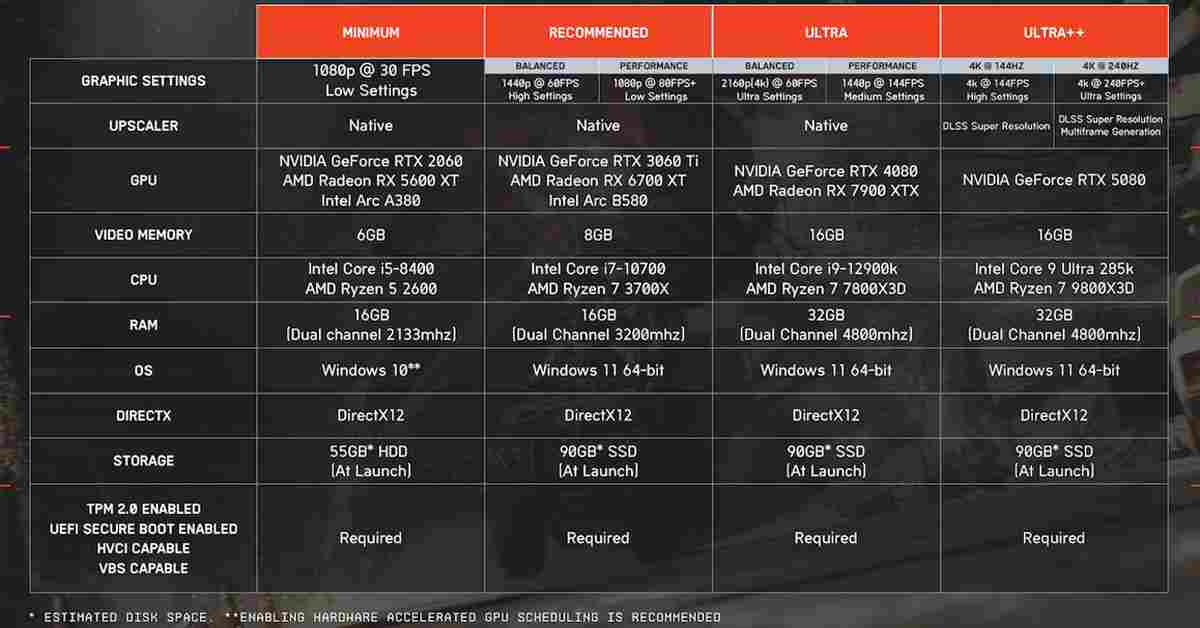
DICE designed this preset for players who want 4K resolution at 144Hz and beyond, not just stable frame rates, but smooth, razor-sharp, ultra-fluid performance. Think competitive shooters on steroids. Every explosion, particle effect, and shadow detail cranked up until your graphics card begs for mercy.
While previous Battlefield games used the “Ultra” preset as the ceiling, Ultra++ adds extra texture fidelity, extended draw distances, and higher-density environmental effects. Basically, it’s what happens when developers decide to showcase everything their engine can do without worrying about mainstream hardware.
Battlefield 6 Ultra++ PC Requirements
Here’s what DICE says you’ll need to join the Ultra++ club:
- CPU: Intel Core 9 Ultra 285K or AMD Ryzen 7 9800X3D
- GPU: NVIDIA GeForce RTX 5080 (or equivalent)
- RAM: 32GB DDR5 (4800MHz or higher)
- Storage: 90GB SSD minimum
- OS: Windows 11 with TPM 2.0 and Secure Boot enabled
Those last two points might sound minor, but they’re not. Secure Boot and TPM are mandatory this time around because the game’s new anti-cheat system digs deep into your system. If you’ve been running an older Windows installation or using legacy BIOS mode, you’ll need to update before the game even launches.
DLSS and Frame Generation Are Your Lifelines
Battlefield 6 isn’t shy about relying on upscaling tech. Even with the beefiest rig, DLSS 4 and Frame Generation are practically mandatory if you want to push past 144FPS in 4K. Without them, you’ll still get great visuals, but you won’t be hitting those dream refresh rates.
This also means the game is built with next-gen GPU features in mind. The 5000-series cards from NVIDIA and the new RDNA 4 lineup from AMD are expected to handle this mode best. DICE clearly optimized for them, using hardware-level AI scaling and frame reconstruction to maintain image quality without tanking your frame rate.
No Ray Tracing (And That’s a Good Thing)
In a surprising move, Battlefield 6 skips ray tracing entirely. That might sound like a step back, but it’s actually smart. DICE has focused on achieving performance stability and competitive consistency instead of shiny reflections.
Ray tracing often drains 40–50% of a GPU’s power budget for visuals that most players barely notice in the middle of a firefight. By cutting it out, DICE freed up resources to boost world density, lighting fidelity, and environmental destruction – the real heart of Battlefield gameplay.
So no, you won’t see your reflection in a car door. But you will see skyscrapers crumble smoother than ever.
The New Benchmark for High-End PCs
Make no mistake-these requirements aren’t designed for average gaming PCs. Ultra++ is essentially a flex mode for enthusiasts. It’s meant to show off how powerful modern GPUs have become and what the new Frostbite Engine 4.0 can do when unchained.
If you’re running an RTX 4070 or Ryzen 7 7800X3D, you’ll be fine at 1440p or even 4K60 on high settings. But to hit 240Hz or beyond in 4K? That’s where the Ultra++ spec comes into play. Only the latest-gen hardware, paired with advanced cooling and a power-hungry PSU, will reach that kind of performance.
DICE also mentioned that this preset uses “dynamic world scaling,” meaning the map complexity and particle density can adapt to your system’s headroom. On Ultra++, you’ll see every dust particle, every spark, and even debris reacting in real time to shockwaves and explosions. It’s cinematic chaos-but smooth.
The Storage Surprise
One nice touch: the game’s install size isn’t as brutal as expected. The full Ultra++ build hovers around 90GB, but players can choose modular installs, skipping campaign or high-res textures if they want to save space. It’s a small mercy in a world where modern shooters often push past 150GB.
This modular system also helps with SSD management. If you’ve got a smaller NVMe drive, you can offload less-used content to secondary storage without impacting loading speeds.
A Security Twist You Can’t Ignore
The mandatory Secure Boot and TPM 2.0 requirements aren’t just technical fluff. They tie directly into Battlefield 6’s upgraded anti-cheat framework, Javelin. It’s designed to run at a kernel level, preventing hackers from injecting scripts or modifying game data.
That’s good news for players who’ve grown tired of cheaters in large-scale multiplayer matches. But it does mean you’ll need a modern motherboard and BIOS setup. Those still rocking older rigs might need a firmware update before installing the game.
The Real-World Impact
For most players, the Ultra++ requirements don’t matter, they’ll never play at that level. But for hardware enthusiasts and pro gamers, it’s a statement. DICE isn’t just chasing realism; it’s raising the ceiling for what’s technically possible on PC.
Games like Cyberpunk 2077 set the tone for visual fidelity. Battlefield 6, on the other hand, seems intent on pushing raw performance, stability, and environmental interaction. Every tree, every wall, and every vehicle is destructible again, but now with precision physics that scale with your CPU cores and GPU throughput.
If you ever wanted to see what a fully dynamic warzone looks like at 200+ frames per second, this is your chance.
Should You Upgrade?
If you’re already rocking a recent GPU and CPU, hold off for now. Battlefield 6 is built to scale well, and DICE has done a decent job optimizing their games over time. You don’t need Ultra++ to enjoy the experience-most of its improvements are visual enhancements rather than gameplay essentials.
However, if you’ve been waiting for a reason to jump to a next-gen GPU, this might be it. The game’s visuals reportedly push 3D rendering tech far beyond 2042’s limits, using advanced AI-driven destruction physics and global illumination.
Final Thoughts
Battlefield 6’s Ultra++ PC requirements are more than just numbers on a box-they’re a glimpse into the future of high-end gaming. DICE has built a showcase for enthusiasts who crave the bleeding edge, and it’s unapologetically demanding.
While most players will stick to more sensible settings, the Ultra++ tier exists as a benchmark, a proof of concept, and perhaps even a challenge: Can your rig survive Battlefield 6 at full throttle?
If not, well your GPU might just thank you for sitting this one out.